Blog · November 5, 2026 · 9 min read
How to Brush Your Dog at Home: A Routine That Actually Prevents Mats
A groomer-style home brushing routine: the right brush for each coat, line brushing step by step, how to reach the skin without brush burn, and how often to brush by coat type.
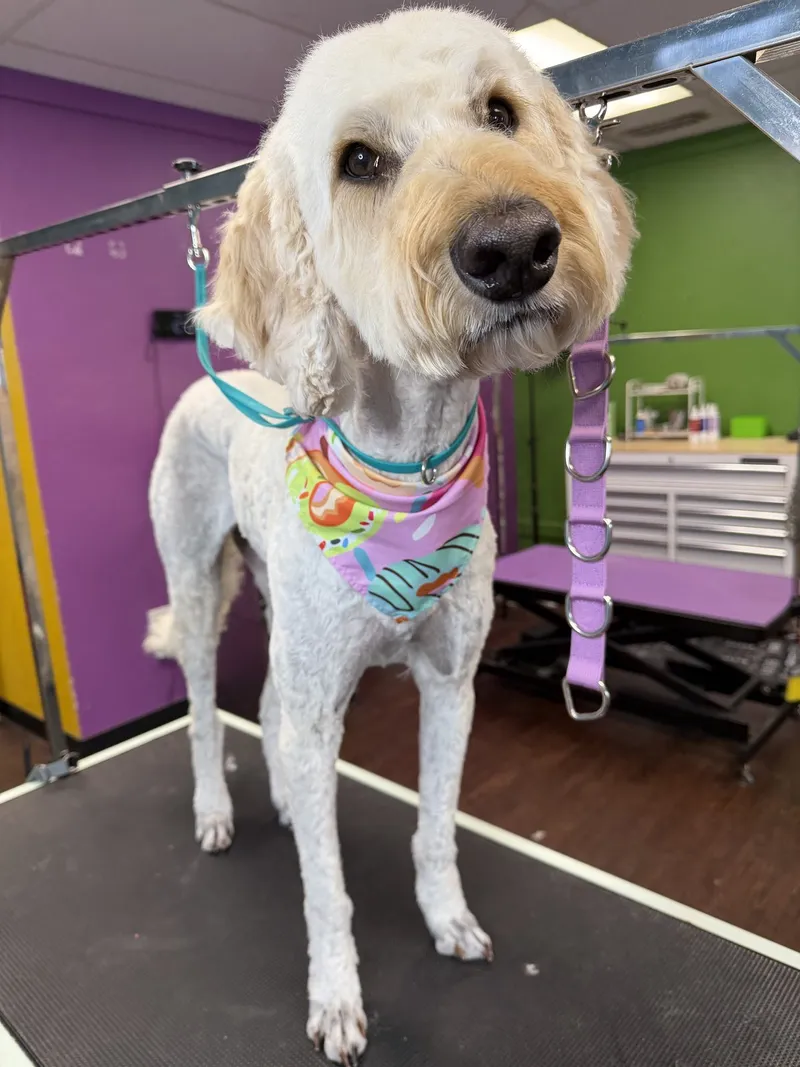
If you want to know how to brush your dog at home in a way that actually prevents mats, the honest answer is this: use a slicker brush to reach the skin, follow it with a metal comb to prove you got there, work in small sections, and do it often enough for your dog's coat type. Most mats don't come from skipping brushing entirely. They come from brushing the top of the coat for months while tangles quietly form underneath.
This guide covers the tools worth owning (and what each one is not for), the line-brushing technique groomers use, how to brush firmly without hurting the skin, which spots mat first, how long a session should take, and how often to brush based on coat type. It applies to pretty much any dog with hair longer than a Boxer's.
Why mats form even when you brush
A mat is loose, shed hair that gets trapped in the coat and knots around the live hair next to it. Friction speeds it up, which is why mats show up under the collar, behind the ears, in the armpits, and anywhere a harness rubs. Moisture makes it worse: a swim or a bath on an already-tangled coat shrinks the tangles into felt.
Mats aren't just ugly. They pull on the skin, trap moisture and debris, and can hide irritation, sores, or an embedded collar underneath. Severe matting can restrict movement and keep a dog from regulating body temperature. A short clip is the kindest fix once a coat is felted, but a good home routine means you rarely get there.
Tools by coat type: what each one is for (and isn't)
You don't need a drawer full of brushes. You need two or three that match your dog's coat, used correctly.
Slicker brush. A flat or curved pad of fine, bent wire pins. This is the workhorse for curly, wavy, and long coats: it reaches through the coat to loosen tangles and pull out dead hair. Buy one with pins long enough for your dog's coat (short-pin for short or puppy coats, long-pin for a full doodle or Golden coat) and flexible enough that they give when you press. Not for: smooth coats like Boxers or Pit-type dogs, where there's nothing to detangle and the pins only irritate skin. Also not for scrubbing hard at a tight mat.
Pin brush. A paddle with long, widely spaced metal pins, often with rounded tips. Gentle on long, silky coats (Yorkie, Maltese, Shih Tzu, Afghan) and good for spreading conditioning spray and finishing. Not for: removing tangles. A pin brush slides over a knot without breaking it up, which is why plenty of dogs brushed daily with a pin brush still arrive at the groomer matted.
Greyhound or metal comb. A steel comb, usually with wide teeth on one end and fine on the other. It does two jobs: it finds tangles the slicker missed, and it finishes areas like the face, ears, and feet. Not for: brushing the whole dog with it as your main tool. It tugs on a coat that hasn't been slickered first.
Undercoat rake. A row of long, blunt teeth that reach through the topcoat and pull out loose undercoat on double-coated dogs (Golden, Husky, German Shepherd, Aussie). Not for: curly or single coats, where there's no undercoat to remove and the rake just rips live hair. Use rakes and any "deshedding" tool with a light hand and stop when loose hair stops coming out. Overworking one area can irritate or cut the skin.
De-matting or detangling spray. A light leave-in conditioner mist. It reduces static, lets the slicker glide, and protects the hair from breakage. Groomers brush most dry coats with a spray for that reason. Not for: dissolving a real mat. Spray makes a tangle easier to work; it does not turn a felted mat back into hair.
Rubber curry brush. For smooth and short coats. Loosens dead hair and dirt and most dogs like how it feels. It's also handy in the bath for working shampoo in.
Leave scissors out of the kit for mat removal. Mats sit tight against the skin, the skin tents up into the mat when you pull, and tears are common. If a mat won't brush out, that's a groomer's job. (More on why brushed dogs still mat, and what groomers do about it, in this post.)
Line brushing, step by step
Line brushing is the difference between brushing a dog and brushing a dog's surface. The idea is to expose a line of skin and brush one thin layer of hair at a time, so every pass starts at the skin.
- Mist the section lightly with detangling spray. Dry hair breaks; damp-not-wet hair slides.
- Lift the coat with your free hand. On a leg, for example, push the hair up from the bottom so you can see a line of skin near the paw.
- Brush the hair below your hand downward, away from the skin, with the slicker. Short, light strokes. You should see skin along the top edge of what you just brushed.
- Move your hand up about an inch and release a new layer of hair over the brushed section. Brush that layer the same way.
- Repeat up the leg until you reach the body, then move to the next section.
- Check with the comb. Comb from the skin outward through the finished area. Glides? Done. Snags? Go back in with the slicker on that spot, then comb again.
If the comb catches on a small knot, hold the hair between the knot and the skin with your fingers so you're not tugging the skin, and pick the knot apart from the outer edge inward with the end of the comb or the slicker. If it's a solid mat that won't give after a minute, leave it for the groomer.
Brushing to the skin without scraping it
New owners usually brush too lightly, then overcorrect and brush too hard. A slicker's pins are wire; dragged across skin with pressure they leave "brush burn," a red, raw patch that stings for days and teaches the dog to hate the brush.
A few rules keep you in the safe zone:
- Let the brush settle into the coat, then pull. Groomers call this pat and pull. Set the pins into the hair, then draw outward. Don't rake the brush into the skin.
- The pressure should feel like a firm fingertip, not a scrape. Press a slicker against your own forearm the way you plan to use it. If it hurts you, it hurts the dog.
- Move from your arm, not your wrist. Wrist flicks dig the pin tips in at the end of each stroke.
- Stay off bare or thin-skinned areas. Belly, groin, armpits, and inside the ears have thin hair and thin skin. Use the comb or a soft slicker there and light passes.
- Don't over-brush one spot. Repeated passes on the same square inch is how brush burn happens. If a spot isn't clearing, the fix is technique or a comb, not more pressure.
Order of body areas and the trouble spots
Work in the same order every time so you don't forget the awkward spots. A common groomer order:
- Legs and feet, bottom up. Feathering on the backs of legs and the hair between toes tangle constantly.
- Chest, belly, and armpits. Armpits are the number-one mat location on doodles and anywhere a harness sits.
- Sides and back, one line at a time. Usually the easy part.
- Neck and collar line. Take the collar off. Hair under a collar is matted on a surprising number of otherwise well-brushed dogs.
- Ears and face. Behind and under the ear flaps first, then the beard and the hair in front of the eyes, with the comb.
- Tail and rear. The base of the tail and the "pants" on the back legs hold shed hair and are easy to skip.
Trouble spots to check with the comb every single time: behind the ears, under the collar, armpits, groin, feathering, between the toes, and the tail base.
How long a session should take
A maintenance brush on a dog that's kept up with runs about 10–15 minutes. A full line-brush on a long-coated large dog can take 30 minutes or more, which is fine to split over two days. If you're routinely spending 45 minutes fighting tangles, the coat is either too long for your schedule or the brushing interval is too long; a shorter haircut fixes both.
Making it pleasant for the dog
Dogs that love brushing were taught to love it. A few habits:
- Start young and start short. Puppies should feel a brush before there's anything to brush. Thirty seconds and a treat is a win.
- Keep sessions short. Stop before the dog gets restless, not after. Several five-minute sessions beat one long wrestling match.
- Pair every pass with something good. A lick mat smeared with peanut butter, or a second person feeding small treats, turns brushing into a routine the dog expects to pay off.
- Brush a tired dog. After a walk or play, not when they're wound up.
- Use a steady surface. A non-slip mat on a table or counter for small dogs, or the floor against a wall for big dogs, keeps the dog from scooting away.
- Don't force it. If a dog freezes, tries to bolt, or snaps, stop. A dog who tolerates handling everywhere else but hates the brush may have brush burn, a mat pulling on skin, or a skin problem worth a vet look.
How often to brush by coat type
These are typical ranges many groomers suggest. Longer coats, swimming, daycare, and harness use all push toward the higher end.
| Coat type | Examples | Main tools | How often |
|---|---|---|---|
| Curly or wavy (hair that keeps growing) | Poodle, Goldendoodle, Labradoodle, Bichon | Slicker, metal comb, detangling spray | Every day or every other day if kept long; 2–3 times a week in a short cut |
| Long silky or drop coat | Yorkie, Shih Tzu, Maltese, Lhasa Apso | Pin brush for finishing, slicker for tangles, fine comb for face | Daily if kept long; 2–3 times a week in a short cut |
| Double coat | Golden, Husky, German Shepherd, Aussie, Pomeranian | Slicker, undercoat rake, wide comb | 2–3 times a week; daily during spring and fall shedding |
| Short smooth coat | Boxer, Lab, Beagle, Pit-type dogs | Rubber curry or soft bristle brush | Once a week; more during shedding |
Doodles deserve one extra note: between roughly 6 and 12 months the soft puppy coat changes to the adult coat, and the two textures knot together. Daily brushing through that stretch prevents the "shaved at 9 months" story a lot of doodle owners tell.
Brush before the bath, not after
Always brush and comb to the skin before a bath. Water pulls loose tangles tight and a wet mat dries into felt. Shampoo also can't rinse out of a tangle, which leaves residue that irritates skin. After the bath, dry the coat completely (a towel followed by a dryer on cool or warm for long coats), then brush again. Never brush a damp long coat; it stretches and breaks.
If a dog is already matted, bathing at home will make it worse, and a professional groom is the better next step. A mobile groomer who can see the coat up close can tell you whether it's a demat or a fresh-start clip.
Common mistakes
- Brushing the surface. A fluffy top layer over a felted undercoat is the classic result. The comb check catches it.
- Using a pin brush as the main tool on a coat that tangles.
- Using a slicker or rake on a smooth coat, which just scrapes skin.
- Brushing top to bottom instead of bottom up, which piles tangles together and hurts.
- Pressing harder when a spot won't clear instead of switching to the comb.
- Bathing a tangled dog.
- Cutting mats with scissors.
- Skipping the collar line, armpits, and behind the ears because the back looks fine.
- Waiting until the coat "looks like it needs it." By then it has needed it for two weeks.
A note from Kansas City
If your dog's coat has gotten ahead of you, or you'd like a groomer to show you a line-brushing routine on your own dog, Pet Rinse Repeat's mobile groomers come to homes across the Kansas City metro. Book a visit on the mobile grooming page and ask the groomer which tools fit your dog's coat.
Frequently asked
- How do I know if I'm brushing all the way to the skin?
- Finish with a metal comb. Pick a spot, part the hair, and comb from the skin outward. If the comb glides through, you reached the skin. If it snags or stops, there's a tangle forming underneath and the slicker only skimmed the surface.
- Can I brush my dog with a human hairbrush?
- Not well. Human brushes are built for one layer of fine hair and tend to glide over a dog's coat without reaching the undercoat or breaking up tangles. A slicker brush and metal comb matched to your dog's coat cost very little and work far better.
- What should I do if I find a mat I can't brush out?
- Stop working on it. Do not cut it with scissors, since mats sit tight against the skin and skin tears are common. Keep the rest of the coat brushed, skip the bath, and let a professional groomer either demat it safely or clip the area shorter.
- Should I brush my dog before or after a bath?
- Before. Water tightens loose tangles into mats and a tangled coat doesn't rinse or dry evenly. Brush and comb to the skin first, bathe, then brush again once the coat is fully dry, never while it's damp.
- My dog hates being brushed. What now?
- Shorten the session to a minute or two, use a softer tool, pair every pass with treats, and stop before the dog gets fed up. If a dog that tolerates other handling suddenly fights brushing, ask your vet to check for a skin problem or soreness underneath the coat.
Sources
- Brushing Your Dog (Purdue University Center for Animal Welfare Science)
- How To Safely Untangle Matted Dog Hair (Chewy, Brittany Kleszynski DVM)
- Coat Care: Preventing Matted Hair (USDA APHIS Animal Care Aids)
- How to Brush a Dog, According to Groomers (Rover)
- How Often Should You Brush Your Dog? (PetsRadar, Dr. Hannah Godfrey MRCVS)
- The Barrage of Brushes and Cluster of Combs (Groomer to Groomer)
- The Pat and Pull Method: How to Use a Slicker Brush Correctly (AllGroom)
- Grooming (Goldendoodle Association of North America)
Next step
Pick a time online — it takes about two minutes.
Or call (816) 606-4951. See pricing or the service page.